


Module 1
Stress and your Brain
We acknowledge that Aboriginal peoples are the custodians of these lands. In doing so, we recognise the diversity of Aboriginal peoples and pay respect to Aboriginal Elders, cultures and heritage.
Understanding Your Brain and the Impact of Stress
Understanding Your Own Brain and Stress
Module 1 is presenting you with an understanding of brain architecture and function in relation to the impact of stress on your brain, bearing in mind that a) you too need skills to manage your stress and b) you rely on your own mental health and wellbeing to facilitate student wellbeing and learning. The brain is considered to be one of the most complex and dynamic systems in the world. Siegel (2020) defines the brain as the “embodied neural mechanism that shapes the flow of energy and information” (p502) furthermore, views the brain as integrally part of the entire body architecture and physiology. Understanding of the brain really commenced with the Renaissance. The Antwerp anatomist Andreas Vesalius was the first to publish a detailed atlas of the human body including the brain in 1543.
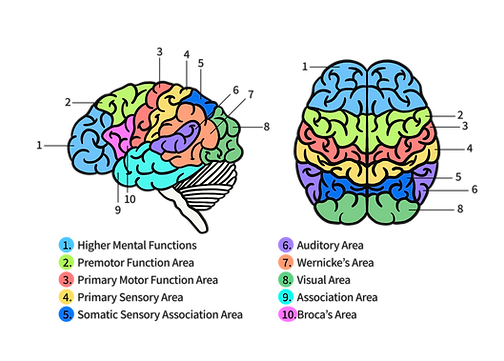
This is an artist’s depiction of the functional areas of the cerebral cortex of the brain.
Understanding Your Own Brain and Stress
-
Think about a time when you faced an immediate stress. It could be hearing news that puts fear into your heart, it could be witnessing something violent or aggressive in the classroom.
-
Where did you feel this in your body? what were you thinking at the time? What memories flooded your mind? How did you react or respond? How do you normally respond to stressful situations?
Image: Functional Areas of the Cerebral Cortex
The Adolescent Brain Under Stress
Did you know that this same response happens in the adolescent brain? The only difference for you is that you are an adult. You have had years to manage stress and self-regulation, by using your higher cortical thinking and through learning and experiences.
Adolescents are learning this level of control however, they function most of the time in the emotional regions of the brain so are far more reactive and emotional. This is a part of normal brain development for adolescents and is explained in Module 2 .
An important thing to know is not to expect mature self-control in many of your adolescent students especially those who have suffered prolonged stress or trauma in their short lives.
Visualising the Brain as an Electrical Network
If you can visualise your brain as a complex network of electrical activity that requires the mind to regulate the flow of energy and information, then you can begin to understand the complexity of brain architecture function and the impact of personal and subjective experiences.
Although there are differences between neuroscientists regarding whether the brain dictates to the mind or the mind dictates to the brain, an eminent Neuropsychiatrist suggests that our minds are broader than our brains and work in an integral way with our bodies and brains in response to information that is received from environmental, experiential, social and relational aspects of our individual lives. (Siegel 2020).
The Cerebral Cortex: A Unique Feature of the Human Brain
While it is not necessary to know the specifics of regions in the brain and because neuroscience is constantly learning more about brain architecture and function, the information here is just an overview. The diagram is showing significant areas of the cerebral cortex and does not reveal all regions.
Try and imagine what your brain looks like inside your head and think about the amazing nature of its architecture and functions.
Main Regions of the Brain
The Cerebrum
(also known as the cerebral cortex or cerebral hemispheres); is the outer part of the brain. It has approximately 7 layers of neurons that cover the whole surface of the brain. You will hear the terms gray matter (processing information and important for mental functions, memory, emotions and movement) and white matter is the communication network (myelinated neurons that transmit information from one region to the other) (Hayes & Stratton (2022)). The cerebral cortex distinguishes us from other mammals as we think (cognition), reflect, interpret, understand and problem solve.
The Brain Stem
is the stalk-like section hanging down between section 9 and the striated cerebellum just above it. The brainstem acts to sustain life by connecting the brain to the spinal cord and controls functions like breathing, heart rate, blood pressure, sleep-wake cycles, swallow reflexes, and holds the cranial nerves that are responsible for sensory and motor functions (Hayes & Stratton (2022)).
The Diencephalon
is located between the midbrain and the cerebrum and includes functions that are like a relay station for sensory information to be processed by the cortex. Includes functions to regulate the nervous systems, structures relating to skin and touch, the limbic systems and motor control (Hayes & Stratton (2022)).
The Cerebellum
(Bayram et al., 2020). This is sometimes called a mini brain and is situated at the back of the brain (see the striated looking bundle near the brainstem in the diagram). Its primary function is to control voluntary movements and balance e.g. coordination. Receives input from the kinaesthetic nerve fibres and balance structures in the inner ear.
Teaching With the Brain in Mind
As a teacher, you are applying the higher functional areas of the cerebral cortex to facilitate your students in optimal learning. On the other hand, you are also an individual dictated by your own personal and subjective experiences and therefore bring with you the highs and lows that have shaped how your brain receives, interprets and imparts information.
White Matter and the Brain's Communication System
By the 19th century it was established that the mass of cortex is white matter consisting of billions of axons emerging from the gray cell bodies in the surface layers of the cortex (see diagram of a myelinated neuron). White matter consists of fibre bundles that link the cortex to every other part of the brain like a giant highway. (Latin term arcuate fasciculi – Latin for arched little bundles).
Language and the Brain
Another thing that distinguishes us from other mammals is we have advanced language skills. This includes communicating effectively in creative ways with all people regardless of ability.
You will note two areas in the above diagram:
Broca's area (BA)
(at number 10 on the diagram) discovered by Pierre Paul Broca, in the left frontal lobe of the brain. The main purpose of BA is language production.
Brain Integration and Neural Activity
Left and right brain functions occur in both a differentiated and undifferentiated way and you might think of the idea of electrical neural activity that is constantly moving toward neural integration
"resulting in optimal self-regulation via the balancing and coordination of disparate regions into a function whole” Siegel (2020) (p. 508).
Wernicke's Area (WA)
(at number 7) discovered by Carl Wernicke, in the upper cerebral cortex (temporal lobe) is concerned with interpretation and understanding.
The Human Mind: A Distinctive Feature
The mind is said to be another distinguishing feature of humans and according to Siegel (2020) involves,
“subjective experience, awareness, information processing and a regulatory function that is an emergent, self-organizing embodied and relational process that regulates the flow of information and energy” (p. 507).
Sources: Siegel (2020)
The Power of Your Nervous System
The Brain and its Protective Mechanisms
The brain is protected by a 7mm thick skull and is surrounded by cerebrospinal fluid.
In addition, it is protected by the meninges, a membrane that is identified as having three different layers according to the areas in the brain that need
protecting. The meninges protect the brain –generally – from physical damage although as neuroscientists are increasingly discovering, for example in
contact sports, the insult of continuous concussions on the brain may seriously disrupt these protective conditions. ·Disease also disrupts the protection
of the brain which is talked about here in discussion of the Blood Brain Barrier (BBB).
The Nervous System
The functions of the nervous system are to receive, analyse and transmit information. The two nervous systems provide anatomical and functional information. Anatomically they include the Central nervous system (CNS) (brain and spinal cord) and the Peripheral Nervous system (PNS) (spinal nerves, cranial nerves and ganglia (groups of brain cells).
The Main Functions of the Nervous Systems
Somatic Nervous System functions
Autonomic nervous system (ANS) functions
referring to activities that are under conscious control, for example, walking, talking, touch and muscle tension.
referring to activities that are under unconscious control, for example, heart rate, blood pressure, respiration digestion and sexual arousal.

According to Porges and Furman (2011) It is important to understand that the mammalian ANS is not just about survival but also forms the basis to early social development that commences with the foetus and is influenced by relational and environmental experiences outside the womb, to lead the developing child to social engagement, independence and maturity.
Based on Polyvagal theory a nerve system ( the vagus nerve) developed early in evolution and “accommodates both fight-flight and social engagement behaviours, to enable rapid, adaptive shifts in autonomic state” Porges & Furman (2011) (p.109). It is this system in the brain that we will discuss in relation to management of stress and trauma both in yourselves and in your students.
Image: Overview of Autonomic Nervous System
Moini, Jahangir. 'Clinical Neuroepidemiology of Acute and Chronic Disorders', 2023. https://www.sciencedirect.com/science/article/abs/pii/B978032395901800016X
The Neuron Cells
A neuron is a basic cell in the brain consisting of a cell body, receiving ends (dendrites) and a long axon that receives, interpret and transmits information. Neurons communicate with other neurons through a synaptic linkage using electrochemical impulses to achieve this. Synapses are like junctions in the road that are unavoidable if you wish to get from one point to the other. Synapses are junctions between neurons that facilitate information transmission. Synapses can be inhibitory (that is, like a brake in the neural circuit -or think of synapses as a police car on the highway that automatically inhibits drivers to slow down. An inhibitory synapse acts to reduce the firing of a nerve cell bringing nerve activity into balance) or An excitatory synapse is like the “go” on traffic signals and acts to induce the firing of a nerve cell to generate important activity between neurons.
Neuroglial Cells
The neuroglial cells have multiple roles, in addition to providing support and keeping neurons functional and free of contamination. There are two significant types of neuroglial cells that will be addressed later in this module.
Image: Overview of Neuron Cells
ADAPTED FROM: US Department of Health and Human Services, 2018. https://www.nichd.nih.gov/health/topics/neuro/conditioninfo/parts
U.S.A. government copyright.

The Blood Brain Barrier (BBB)
The BBB refers to the barrier between the brain’s blood vessels and supply, to protect brain tissue from toxins and damaging bacteria. Similarly, to create a barrier between physical damage to the brain from concussion or physical trauma. Invasions of bacteria or viruses for example, bacterial meningitis can breach the BBB, resulting in disease that impacts on brain architecture and function.
Image: The Blood Brain Barrier
ADAPTED FROM: C. Catherine.'Blood Brain Barrier (Simple Longitudinal Zoom)'. BioRender. https://www.biorender.com/template/blood-brain-barrier-simple-longitudinal-zoom
Created with BioRender.com

The Arousal System in Adults
Age Related Arousal Effectiveness
Trauma, prolonged stress and impact of Adverse childhood experiences impact on adolescent and adult brain function manifesting in a wide range of
behaviours.
First 3 Years of Life
-
Foundational for learning, emotional and social skills development
-
Experiences, relationships and interactions shape brain development and health of ANS
-
Rapid brain development.
Early-Mid Adulthood
-
Neural Integration
-
Risk averse based on experience and mastering
-
Cognitive and regulatory control
-
Efficient SNS and PNS
-
Although in young adults this can be unpredictable
Adolescence
-
Moving toward Neural integration
-
Risk taking
-
Impulsivity
-
Peak onset of mental health disorders at age 14 years
Older Adulthood
-
May experience dysregulation in Autonomic Nervous system Re Impacts on physiology
-
Increase in SNS activity and decrease in PNS activity
The Sympathetic Nervous System (SNS)
The SNS comprises a network of nerves that helps your body to activate the reactivity response known as flight, fight, freeze when you are faced with a stressful, dangerous or frightening situation (Cleveland Clinic).
The Arousal system in humans consists of the Sympathetic Nervous System (SNS) (excitatory) and the Parasympathetic nervous system (PNS) (calming)
Generally, the arousal system in adults effectively regulates essential body systems and employs higher order decision making to facilitate self- regulation in response to stimuli.
An example of this may be :
You are in the classroom, there is a student in the room whose behaviour has often been problematic. They can become verbally abusive and aggressive, and you are not always aware of something happening in the classroom until this student erupts.
When this happens think about:
-
What happens in your body? Your heart starts pounding, your mouth goes dry, you feel a prickling sensation in your scalp, your body feels tense.
-
You are alert to what this student may do. Given you have been teaching at this school now for 6 years, and you are familiar with many students like this, you have your own ways of starting to calm yourself so that you can manage this student.
-
This is because you have achieved mature Neural Integration and therefore you can be assured of the efficiency of your arousal system, that the feelings pass very quickly and .you may already have developed ways to cope for example, long slow deep breath. If so, you can manage this situation and also help the student to get back to equilibrium.
-
If you have experienced trauma yourself or are irritable or stressed then, like the student you may not be able to manage the circumstances without reliving your own trauma or without becoming reactive. If this student is really challenging, you will have to work harder to maintain calm and control over yourself, and other students in the class as this student may not settle quickly and you and other students will be badly affected.
At this stage in your training, just know that healthy timing of arousal and return to calm is usually rapid and if managed well can be over very quickly. This is part of your role as a teacher, handling stress in yourself and the student/s, that the student too can learn to manage their own stress more effectively.
Note well - for students who are functioning in reaction to prolonged stress or trauma the arousal timing can be much longer. Learning effective strategies to de-escalate are addressed in module 4 or to initiate crisis intervention, this will be addressed in detail in module 5 .
So How Does the Adult Arousal System Work?
Research has demonstrated there are age and sex differences in how much cognitive and emotional control adults maintain through the arousal system. Adults are generally more risk averse due to maturation of higher order thinking and because of experiences. An interesting point to think about - according to Sullivan et al (2021) associations between phasic arousal (the transient increase in physiological activation in response to stimuli) and decision making, are at risk in younger and older adults. Adults with a history of prolonged stress or trauma may present with excessive reactivity to triggers of stress with varied behavioural presentations.
Fluctuations in Physical Arousal Affect Information Processing
For example, hearing a baby cry may trigger an arousal response that is associated with the release of norepinephrine throughout the brain, producing a momentary increase in alertness and empathy or, depending on your experiences, anxiety. Aging is associated with deterioration of neurons within the frontal lobe and hippocampus and impact on speed and efficiency of communication between neurons. This is typically between the ages of 60 and 70 while the overall brain changes in volume and structure commences from around 40 and accelerates around 60. This change in neurons is normal and not necessarily about dementia. These changes also vary in individuals depending on your lifestyle, physical activities and choice of employment etc.
Myelinated Neuron
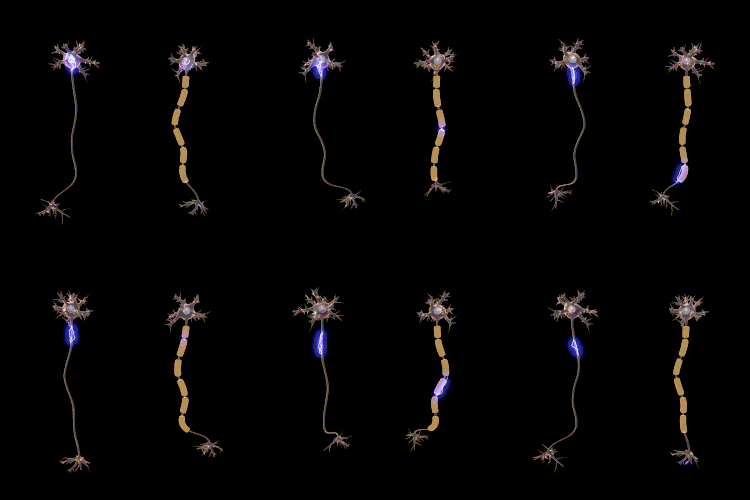
This strange looking item is a neuron which makes up approximately
10% of all cells in the brain population. Neurons are cells that receive or relay information – through a form of electrical impulses. There are 3
main types of neurons, sensory, motor, and connector neurons
Bayram-Weston et al.(2022). A typical brain has 86 billion neurons
which are all shapes and sizes and trillions of glial cells (Siegel 2020).
Glial cells make up 90% of the brain cells. Think of them as if they were
a massive highway system the main purpose of which is to keep neu-
rons safe. Glial cells are fundamental cells in the nervous systems, are generally smaller than neurons and provide support and protection to neurons through myelin production and regulating blood flow.
Microglia perform important immune system functions to regulate inflammation and therefore repair and growth functions (Hayes, N. and Stratton, P. (2022) Think of them as the sentinels located throughout the brain environment and fighting off enemy invasions (infections)
Image: Myelin
Doctor Jana, 'Saltatory Conduction - Lets jump the signal'. DocJana.com. 2016. https://docjana.com/saltatory-conduction/#
Unmyelinated
Myelinated
Glial Cells and Brain Function
The Glial Cells
Glial cells are those fundamental cells whose primary function is to provide nutrients, clean up contamination in neurons, provide myelination and more recent neuroscience suggests, glial cells have a structural scaffolding effect on maintaining effective functioning of the neurons.
Think of it as the neurons being the cars on the highway and the glial cells providing the maintenance and structure to keep the cars safe Hayes & Stratton (2022); Siegel, (2020); Bayram-Weston et al., (2020)
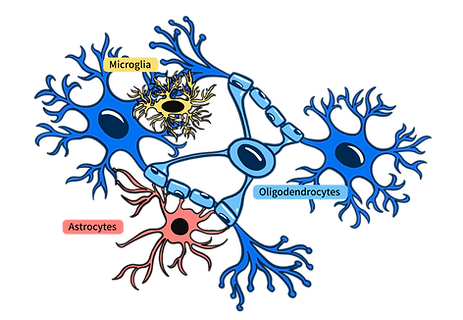
The following three types of glial cells are found in the central nervous system (CNS)
Astrocytes
Image: Three different types of glial cell
Astrocytes provide metabolic and structural support, help maintain balance in neuronal environments; protect neurons from toxicity; promote synapse formation, transmission and plasticity; help stabilize BBB to name some of their roles.
Astrocytes keep your brain healthy by giving it energy, getting rid of excess neurotransmitters, working with metabolism and brain repair.
Astrocytes also protect brain tissue that may be vulnerable to medical conditions, for example, to prevent disease from crossing the blood brain boundary. (BBB)
Astrocytes are often found to deteriorate in old age or neurodegenerative conditions. Think of them as border soldiers keeping infection away from the brain.
Oligodendrocytes
Oligodendrocytes from a Greek term meaning branches.
Oligodendrocytes are located in the central nervous system and are responsible for proper functioning of the CNS. They form a multiple layered protective level of myelin along the axon of a neuron.
Microglia
Microglia enter the brain during the embryonic stage of a foetus and have a role in promoting immunity, regulation of brain development, maintenance and repair of neuronal networks and exist throughout the central nervous system.
Microglia make up approximately 5-15% of the total number of brain cells.
Microglia play a monitoring role in maintaining CNS “microenvironments” Luo and Wang (2024) (p.2.)
Recent neuroscience research has revealed that “damage to microglia plays a key role in the development of ASD” (p.2) and impact on synaptic pruning leading to social behaviour problems.
+ Schwann cells
Schwann cells are also involved in myelination however in the PNS (Bayram-Weston et al., (2020)).
The Interconnecting Nervous System
Self- Regulation and the Interconnecting Body
Levine, P. A. (2010) In an Unspoken Voice: How the body releases trauma and restores goodness

This diagram shows the layout of the Nervous system in terms of self-regulation and parts of the body involved. The management of stress is primarily located within the roles of the Peripheral Nervous System (PNS) network however, interacting with a chemical process originating in the Endocrine system through the Hypothalamic Pituitary Adrenal Axis (HPA – axis) located in the Central nervous system. In addition, there is a role for the unmyelinated primitive vagus system (found within the CNS) in causing immobilisation, shutdown, dissociation in the face of extreme stress or feelings of helplessness that are associated with imminent death. The myelinated Vagus system on the other hand, plays a definitive role in social engagement integral to the Parasympathetic processes of calming and self-regulation (See Levine, P.A.(2010); Porges and Furman (2020). Looking at this chart think of the terms previously mentioned. That is autonomic (unconscious control and unconscious functions) left of screen, and Somatic (conscious control and controlled functions) right of the screen.
Returning to the left side of the screen under the Autonomic system are two branches:
The Sympathetic (Arousal, fight, flight) and Parasympathetic (calming).
Notice to the right of the parasympathetic there is identification of the unmyelinated primitive vagus system identifying shutdown and dissociation. This can be thought of as calming to the point of shutdown.
If you think of the example of an animal surrounded by predators, their body completely shuts down as they prepare for inevitable death. This too can occur with humans if there is an inevitability of death impending. That is, it may be described as: “I couldn’t move, and a calmness came over me. I knew I was going to die”. Of course, if that animal views a break in the circle of predators, the Sympathetic system clicks in and they either fight or flee.
The arousal/calming system is a highly protective system.
The more extreme the danger or perceived danger, the bigger the capacity for the body and brain to dominate overall function and suppress certain neurological subsystems in the interests of survival.
Think of a situation where someone near you loses control. This may have been in the classroom or may have been in a supermarket or at a government service outlet.
How does this make you feel? Were you scared? If yes, where did you feel this in your body?
What helped you to feel calmer?
If you can reflect on these points and find an answer to any part you are beginning to become aware of the functions of your ANS.
The next section then identifies what occurs in your body and brain at the point of arousal.
The issues of suicidality and self-harm will be discussed in module 5 as these are complex in their neural activity and need special understanding as depicted in module 5.
The Autonomic Nervous System
The ANS
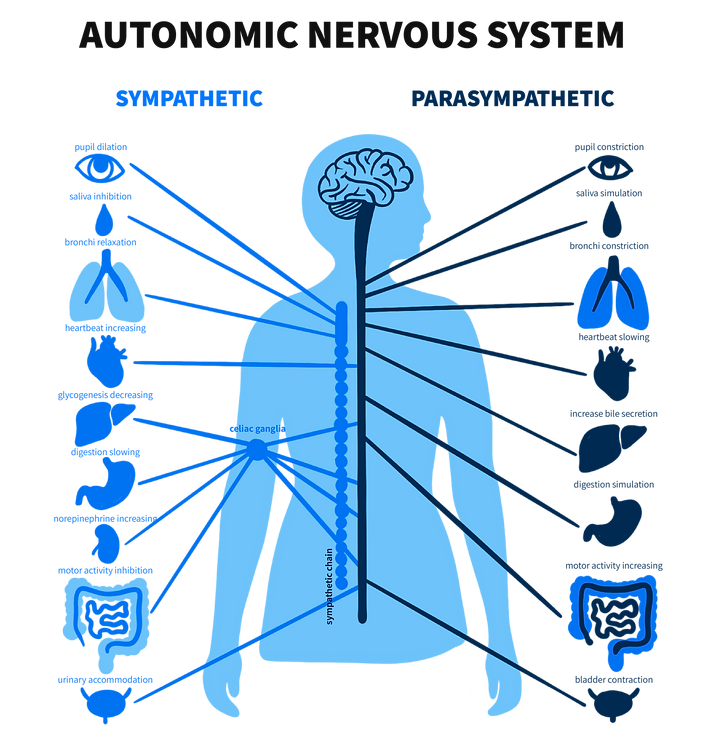
Image: The Autonomic Nervous System
In ANS the first link therefore is between physiological responses and mental processes that have come from experience. This depicts how the ANS works. The Sympathetic nervous system demonstrates what happens in your body when the primitive arousal system is stirred up. Commencing from the top left side of the diagram.
In the classroom you are verbally assaulted by a student known to get quite intimidating, your eye pupil dilates, you get a dry mouth, the blood volume in your heart is increased. (on an unconscious level your arousal response is one of getting ready to fight or flee (don’t forget the Primitive vagus nerve in the PNS is responsible for slowing down all systems when it seems inevitable that you won’t survive) At the same time the parts of your body that normally secrete and expel shutdown. You get a boost of glucose to give you energy and your sympathetic nerves close the bladder neck by constricting the urethral sphincter. As a teacher you can’t simply walk out of the classroom so how do you manage this student and the rest of the class?
Write down an experience you have had like this. Share it with another teacher and compare notes about what they remember happening in their body. Write down how you managed the situation. Did this work to calm that student, What was happening in your body when everything started to calm down?.
Can you describe how you felt? (don’t forget the opposite happens in the Parasympathetic systems) That is everything relaxes for example you can feeling your heart slowing down and your breathing changes. Can you describe what happens to you in the classroom? How do you manage this. Share what it feels like with another teacher and find out if they experienced the same or similar things. How long did it take for your PNS responses to click in. We will be looking at the adaptive responses in the next slide but before we get there its important to understand that the transmission of information regarding an incident in class also involves two important neurotransmitters.
The 2 Main Neurotransmitters involved in the ANS
SYMPATHETIC
PARASYMPATHETIC
Norepinephrine
Acetylcholine
Heart – stroke volume (SV) increases the volume of blood pumped from the ventricle per beat.
Mydriasis - dilation of the pupil
Heart – HR – heart rate number of heart beats per minute reduces.
Miosis – constriction of the pupil.
Neurotransmitters; Molecules and Molecular Messengers
NEUROPEPTIDES
(peptides – small subunits of proteins) more than 40 found throughout the brain.
Glutamate most widespread excitatory neurotransmitter in the cortex. And GABA (Gamma-aminobutyric Acid)-common inhibitory neurotransmitter – lessens the nerve cells ability to receive, create or send chemical messages to other nerve cells. Known for producing a calming effect associated with anxiety or stress.
Sequence and context – The ANS reacts not only when energy is required to perform an action but also when emotional significance is associated with the action, (meanings attached to experience. Although some neuroscientists say we are programmed to have negative beliefs in order to survive, someone who has experienced trauma or prolonged stress causing fear etc in early life can get stuck in rigid and inflexible belief systems. This might be the student who can’t trust anyone, or feels unlovable, needs to fight before someone fights them etc., i.e. limited pre-judgment named pre-mature cognition. It may also be a student who self-harms to feel alive or to express heightened anxiety about criticism. This may or may not happen in the classroom.
Behaviour Subsystems
BEHAVIOUR SUBSYSTEMS
Gestures; emotions; posture, autonomic, visceral and archetypal behaviours.
Gestures – most conscious behaviours are voluntary, many superficial nevertheless convey feelings.
Emotion – facial expressions, tone of voice
Posture – mirror neurons subconsciously register the postures of others
Autonomic Signals
Respiratory
Cardiovascular
Breathing that is rapid, shallow and or high in the chest indicates Sympathetic arousal. Almost imperceptible breathing frequently indicates, immobility, shutdown and dissociation. Breathing that is full and free with complete expiration before the next inhalation indicates relaxation
NB – Don’t ask someone who is functioning at sympathetic arousal level to take a deep breath. The effort can sometimes exacerbate nervous system imbalance. Same with touch, standing too close, standing over. The way to manage these events is very dependent on what triggers have preceded the reaction or whether they need de-escalation for example, through quiet coaching/talking or someone being near who they are comfortable with, and trust or full crisis intervention is required. Strategies to manage these events will be addressed in modules 4 and 5.
Heart rate - when rapid can often be seen pulsating in the carotid artery of the neck
Changes in blood pressure – strength or weakness of pulse – Brain mapping includes tracking pulse rate and breathing throughout the day/week.
High tone = vasoconstriction – fingers may be cold or bluish white (sympathetic hyperarousal ) means blood has left extremities to prop up the heart and muscles getting ready to flee, can represent Fear
A sudden red flush ` in face and neck- can reflect, anger, shame, embarrassment. On the other hand, this can mean a charge of energy that is positive.
Opthalmalogical
Pupil of the eye – size wide indicates high sympathetic arousal, pinpoint can mean immobility (or opiate drugs)
Muscular Skeletal
Tension in shoulders, flexing shoulders, twitching legs, tapping feet, sweaty hands, dry mouth.
The role of the Vagal nerve in the PNS
Stephen Porges suggested it provides one aspect of the social engagement system (social brain) that is activated when the prefrontal cortex assesses conditions of safety a) if safe, social engagement can take place.
When danger is identified the social engagement system is shut down, the sympathetic nervous system locks in. Blood pressure and the body prepares to fight, flee or activate freezing.
If the prefrontal region assesses inevitability that there is no escape, part of the parasympathetic system controlled by the vagal nerve locks in blood pressure drops, heart rate plummets and individual goes into a “flaccid” or fainting state.
Adaptive Response

Perry, B. D. (2020). The Neurosequential Model: A Developmentally Sensitive, Neuroscience Informed Approach to Clinical Problem-Solving. In J. Mitchell, editor.; Tucci, Joe, editor.; Tronick, Edward, editor. (Ed.), The Handbook of Therapeutic Care for Children : Evidence-Informed Approaches to Working with Traumatized Children and Adolescents in Foster, Kinship and Adoptive Care (1st Ed). (pp. 114-131). Jessica Kingsley Publishers.
A significant fact: Initial Sympathetic reactions pass quickly and handled well individuals can get back to normal quickly however, this is a much longer and harder thing to achieve with those who have suffered ACE’s trauma or prolonged stress.
This section shows varying degrees of intensity and sensitivity in the brain’s response to stress. Moving from left to right demonstrates what Perry 2020 identifies as “the state dependence” of the brain. This means that individuals exposed to prolonged stressors are functioning at the lower parts of the brain, not at cortex level. The foundation of emotional processing is the appraisal-arousal system, which can respond with varying degrees of intensity and sensitivity. This shows the adaptive response of the brain in situations from poor self-regulation through to good self-regulation- red to pale blue (executive behaviour regulation)
Row one represents the type of response. Row two represents the parts of the brain in which you will find these responses. The bottom row represents the emotional reaction to the trigger (whatever this may be).
Escalation from trigger = the type of reactiveness to expect
De-escalation conditions required, to correct the trigger response/reaction
NB Levine has developed strategies for restoring someone from a state of immobility or dissociation (freeze and shutdown if prolonged) back to the sensory aspect of fight and flight through recognition of body sensations and self-awareness. For example, specific strategies in the moment and mindfulness techniques as a matter of course and increase in awareness. Each of us has a “threshold of response” and those with hair trigger response mechanisms will find life is filled with challenging situations. Messaging from the brain provide prompts according to the sensitivity of the individual and the situation and modification from experience. Also modified by genetic factors.
Emotional regulation is also determined by which parts of the brain are activated. Examples – Recent disclosure from someone who was at the Port Arthur Massacre represents a classic example of someone so traumatised that they became very calm believing that he was going to die. This reaction can be seen in animals who are surrounded by predators, become limp and immobile however, the minute an opening occurs they are filled with the nervous activity that allows them to attempt an escape.
Program - https://tvtonight.com.au/2024/07/not-just-tragedy-porn-i-was-actually-there-from-port-arthur-to-the-beatles.html
Calming Music Exercise
This section provides a track to a piece of music as an example of what can help to calm you when you are stressed.
Listen to this track and reflect on:
a) Whether it helps you to feel calm and
b) if yes, does it have a memory association or does it allow your mind to wander into new places or places that you cherish.
c) does it have a negative memory association.
d) What other musical tracks facilitate calmness for you
e) when might some of these tracks be worthwhile playing in class. How different might your responses to be for others and how might you manage individual differences in class when choosing music.
Music will be addressed as a strategy for prevention of disruptive behaviour in the classroom in module 4.
Video: Classical music option for exercise
Frédéric Chopin - Topic. 'Nocturne No. 2 in E flat Major, Op. 9,2'. YouTube, 2015. https://youtu.be/bVeOdm-29pU?si=zOJ8SEgp4FxHyuyh
1
The content of your Central Nervous system is high in
water and fat and is highly susceptible to damage.
When you listen to a high musical note your auditory nerve is firing as fast as the sound waves that vibrate your eardrum
The fastest reaction time to a stimulus is about 100 milliseconds and...the time it takes for a sensory stimulus to become conscious is typically a few hundred milliseconds.
Long term heavy alcohol and/or drug use changes the brain and causes significant reduction in size of neurons.
Overuse of technology is undergoing intensive fMRI studies to measure potential damage to structure or function.
FANTASTIC
FACTS
The brain is still the most complex structure known
to humankind.
3
2
4
5
6
These are some very interesting facts about the awesome power of your brain and the importance of addressing all relational and environmental experiences that can impact on optimal brain health.
Inspirational Quotes
These are inspirational quotes from the following Neuropsychiatrists and Psychotherapists who have a profound knowledge and expertise in the brain,
mind and body functions of those who have experienced prolonged stress or trauma.
“Empowerment derives directly from expelling the physical attitude of defeat and helplessness and restoring the biologically meaningful active defence system- that is, the embodied triumph of successful protection and the visceral actuality of competency”
(Levine, Peter, 2010p.85)
Peter Levine is an American Psychotherapist who has worked for many years with clients who have experienced trauma. This quote is from “An Unspoken Voice: How the Body releases Trauma and Restores Goodness” . It is relevant to yourselves as teachers and to students regardless of the ACE’s they have experienced or the in school difficulties they may have encountered. It represents how the “downstairs brain” as Siegel names it, is well equipped to bring the body and emotions back into balance after experiencing ACE’s and how with patience, understanding and collaboration between those who have experienced trauma/stress and those who are there to support them, can restore well being and health.
“The capacity to solve problems is greatly enhanced when we work collaboratively in groups with an integrated process”
(Siegel, D.J. 2020 p. 414)
“Name it to Tame it”
(Siegel, D.J. 9th December 2014)
Dr. Dan Siegel, is a Neuropsychiatrist famous for his research into child and adolescent brain function and therapy with clients relating to attachment dysfunction, stressful life and family dynamics and prolonged stress or ACE’s experienced by adolescents, children. His book “The developing Mind” (2020) is a masterful exploration of the relationship between development of mind and the dynamics of brain architecture and function as a vessel to facilitate self -awareness and development of mind rather than mind dictated by brain. The link provided here is developed by Dr Siegel and is worth a watch. Reflect on this when we address classroom strategies in module 4, for example COGENS.
Module 1 Conclusion
At the end of this module, you will have a much better idea of how your body and brain are intricately modelled to cope efficiently and quickly with all diff-
erent kinds of stressors.You have learned something about the neurobiological processes in brain function, for example, neuronal activity, how the brain is protected from infection. You will now have more information about the Arousal system in the human body and brain, the impact on this system of chronic stressors and how that may appear in behaviours. The next module is looking at The Adolescent brain, and what that means regarding behaviours and
learning.
Thank you for attending Module one. We hope you will find the Adolescent brain enlightening as well.